AI Exposure: Governed. Assured.
Quantified in Dollars.
$1 trillion invested in AI since 2020.
84% of Fortune 500 leaders say AI is critical to their future.
Only 11% have adequate governance in place.
That gap is the single largest unquantified EBITDA risk category in the enterprise.
ArxIQ™ is the only platform that automates both layers enterprise AI deployment requires:
-
1) structural trust (is the system safe?) and
2) financial trust (what’s the EBITDA exposure?) — connecting AI technical lineage to business process impact to dollars without manual assessment.
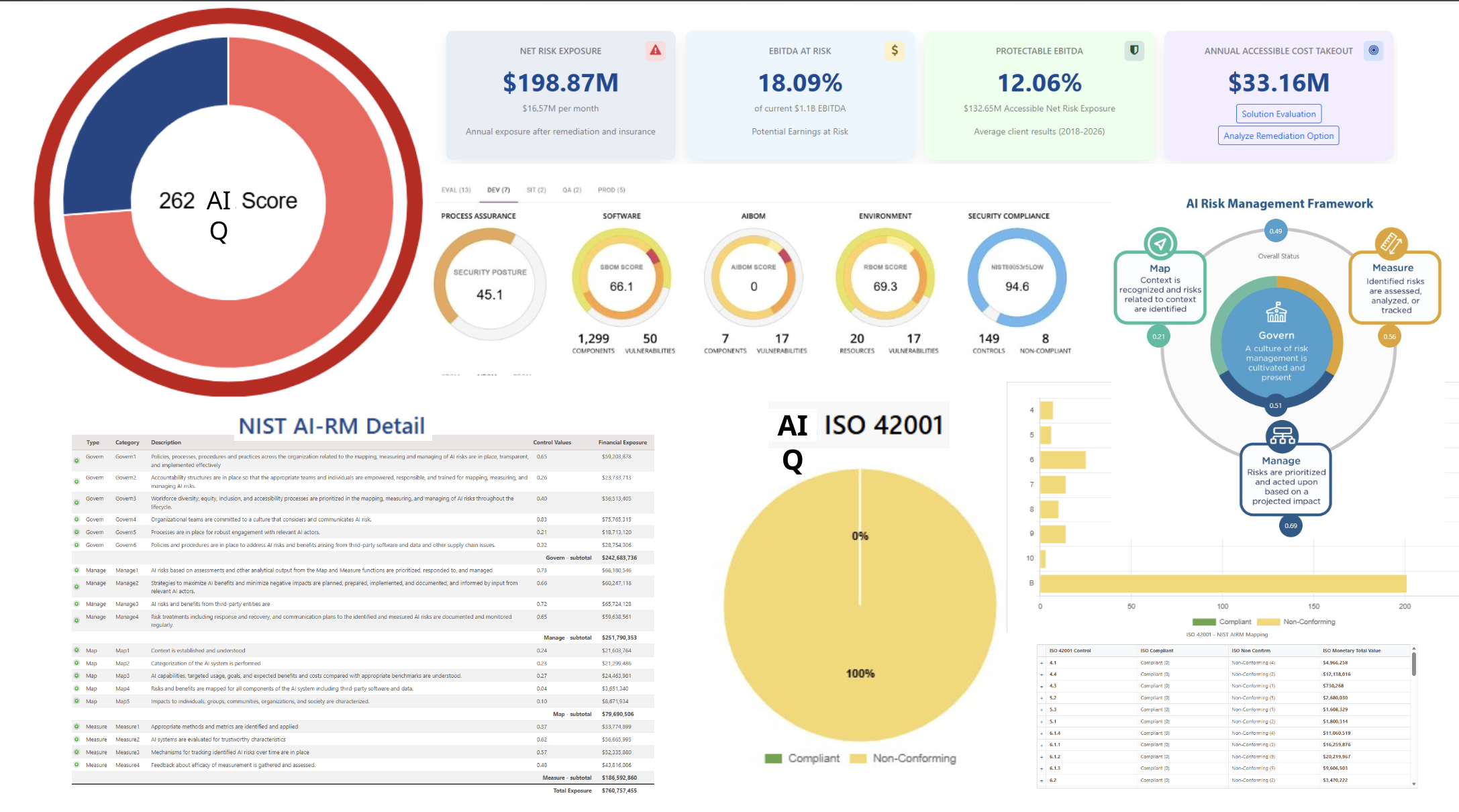
Why AI Exposure Requires More Than Governance Checklists.
84% of Fortune 500 CIOs/CEOs say AI is critical to future economic success.
Only 11% have adequate AI governance in place.
(KPMG 2025)
426 AI regulations
already adopted globally.
400+ more already under discussion.
THE CIOs 3 UNANSWERABLE AI QUESTIONS
The board says deploy AI. The COO wants operational benefits. The CIO has to sign off — and is asking questions no one can answer:
“What is this AI system actually made of?” (no formal auditable inventory exists).
“How do I know it’s safe?” (vendor self-attestation is not independently verified).
“What’s my financial exposure?” (the board cannot authorize a deployment they cannot quantify).
These three questions require two trust layers the AI vendor alone cannot provide.
THE AI REGULATORY TSUNAMI
426 AI regulations adopted.
EU AI Act in force.
NIST AI RMF mandated by executive order.
State-level AI laws accelerating.
Sector-specific requirements emerging (Federal Reserve SR 11-7, NAIC ORSA, ASOP 56, BSEE/PHMSA for oil and gas, FDA/HIPAA for healthcare).
Organizations cannot manually crosswalk assessments across 800+ evolving frameworks.
Manual compliance is no longer viable at this scale.
OPINION-BASED AI GOVERNANCE
Existing AI governance relies on subjective frameworks, maturity questionnaires, and professional opinion.
These produce qualitative assessments that fail under audit scrutiny and cannot connect AI risk to EBITDA impact.Boards ask “How much AI exposure do we have?” and get heat maps instead of dollars.
The AI vendor cannot solve this alone — a vendor certifying their own system’s safety is like a restaurant grading its own health inspection.
Without automated, actuarial quantification, AI exposure remains opaque, unmanaged, and indefensible.
Boards face fiduciary exposure without financial truth.
Two Trust Layers Enterprise AI Requires.
One Automated Platform That Delivers Both.
ArxIQ™ is the only platform that automates both trust layers in one actuarial engine — replacing manual questionnaires, subjective assessments, and fragmented workflows with continuous, machine-driven governance and quantification:
Structural Trust Automated proof that your AI systems are |
AI GOVERNANCE:Where the gaps are.
|
AI ASSURANCE:Automated proof that what you deployed works.
|
Financial Trust Automated financial intelligence |
FINANCIAL QUANTIFICATION:Actuarial EBITDA exposure metrics computed automatically.
|
Why Both Layers Are Required.
Structural trust without financial quantification:
IT approves the deployment, but the CFO has no financial basis to authorize budget, and the board has no basis to approve the risk. Governance without dollars is governance without decisions.
Financial quantification without structural assurance:
The financial model covers the cyber perimeter but misses AI-native risks — model bias, hallucination rates, prompt injection susceptibility, component-version vulnerabilities. The risk picture is incomplete.
ArxIQ™ automates both:
Complete structural assurance feeding complete financial quantification — continuously, automatically, without manual intervention. The CIO approves. The board authorizes. The deployment proceeds with quantified, governed risk.
Powered by the same patented actuarial AI engine built on NIST-designed methodology and trusted by insurers covering 35% of the S&P 500.
What ArxIQ Automates.
-
Automatically applies actuarial loss distributions validated by insurance industry data to quantify AI risk in EBITDA terms.
-
Eliminates subjective scoring with audit-defensible, repeatable estimates.
-
Produces Apparent Risk (total exposure before controls), Residual Risk (remaining exposure after governance), and the quantified dollar value of your governance investment.
-
Automatically maps quantification to NIST AI RMF and ISO 42001.
-
Methodology validated within 7–8% of real-world losses.
-
47,000+ threat-vulnerability pairings covering the cyber dimension of AI risk, automatically extended with AI-native threat vectors.
Three interlocking artifacts automatically generated to establish a complete chain of custody for any AI system:
AIBOM (AI Bill of Materials):
-
Automated inventory of every AI-specific component — foundation models and versions, training data provenance, fine-tuning datasets, embedding models, vector databases, orchestration frameworks, prompt templates, guardrail configurations, and AI service APIs.
-
Automated extraction from Hugging Face and model registries, including emerging agentic AI architectures.
SBOM (Software Bill of Materials):
-
Automated inventory of conventional software infrastructure underlying the AI system — libraries, APIs, container images, cloud services, deployment dependencies.
-
Connects AI deployment to the existing SBOM governance process the CIO’s team already trusts. Not a new governance paradigm; an extension of one that already exists.
RBOM (Risk Bill of Materials):
-
Automated risk mapping layer assigning vulnerability scores to every specific component version in both AIBOM and SBOM.
-
Integrates CISA NVD and KEV catalogs plus AI-specific risk assessments.
-
Drill-down to lowest component-version risk within any business process.
-
Continuously and automatically updated as new vulnerabilities are discovered.
All artifacts are human and machine readable — formatted for human audit review and automated ingestion by GRC platforms, security tools, and regulatory reporting workflows.
Cryptographically hashed, tamper-evident, CycloneDX-compliant. 90+ model assurance probes automatically run bias detection, prompt injection susceptibility testing, hallucination rate measurement, and known vulnerability scanning — producing quantified assurance scores that feed both the RBOM and the financial risk model. When new vulnerabilities are discovered, these structured artifacts enable immediate automated identification of affected components and prioritized mitigation. Developed in partnership with CISA.
The result: when the CIO’s security team asks “what is this AI system made of and how do I know it’s safe?” — the Assurance Triad provides a formal, auditable, machine-readable answer that replaces ad hoc vendor questionnaires and weeks of manual review.
-
Automatically links each AI model to its business context: which entity owns it, what process it supports, what revenue stream it affects.
-
Quantifies EBITDA exposure by business process (e.g., Personnel Security: 58% of risk = $7.7M, concentrated in Mortgage Processing).
-
Maps exposure to specific revenue streams (e.g., $12M in Consumer Lending vs. $3M in Wealth Management).
-
Automatically calculates remediation ROI per action (e.g., $50K spend eliminates $2M exposure = 40:1 return).
Interactive relationship mapping:
Models → Data Sources → Business Processes → Financial Impact.
Dependency chain visibility shows cascading upstream and downstream effects when any model changes or fails.
Automated version tracking, detecting model drift, and undocumented changes.
Process-level assurance scoring:
-
The knowledge graph automatically connects the organization’s specific operational workflows to the exact AI models, data sources, and software components that power each workflow.
-
This enables assurance scoring per process — not just “is the AI platform secure?” but “what is the assurance score of our Production Surveillance workflow specifically?”
-
When a new vulnerability is discovered in any component, the knowledge graph automatically identifies which business processes are affected and the assurance score updates without manual intervention.
Role-specific stakeholder views:
-
CFOs see EBITDA exposure
-
CISOs see security controls
-
CIOs see governance status
-
Pperations see process impact —
all from one automated source of truth.
-
Automated NIST AI RMF assessment with control family evaluation.
-
Automated ISO 42001 alignment for multinational operations.
-
Automated crosswalk across evolving frameworks — assess once, map to all. EU AI Act (Article 96), EO 14110, state regulations, sector-specific requirements (Banking SR 11-7, Insurance ORSA/NAIC, ASOP 56, BSEE/PHMSA for oil and gas, FDA/HIPAA for healthcare).
-
With 428 global AI frameworks today and 400+ emerging, automated crosswalking is the only viable approach.
When frameworks evolve, the crosswalk updates automatically — your compliance posture stays current without re-assessment.
-
Automated multi-initiative analysis from individual projects to enterprise-wide portfolios.
-
Materiality-based prioritization automatically ranking AI initiatives by quantified EBITDA exposure, not subjective scores.
-
Portfolio optimization automatically calculating exposure-to-value ratios — identifying which AI projects carry disproportionate risk relative to business contribution.
-
Board-ready dashboard with KPIs, trend analysis, and industry benchmarks — generated continuously, not quarterly.
What Organizations Use ArxNimbus AI Exposure Intelligence For.
Enterprise-wide visibility into every AI initiative — who owns it, what process it supports, what EBITDA it exposes.
Automated board-ready dashboards replacing qualitative maturity assessments with actuarial financial metrics.
Prioritize remediation by measured EBITDA impact, not subjective risk scores.
Automated NIST AI RMF, ISO 42001, and EU AI Act compliance with crosswalk automation across 800+ frameworks.
Cryptographically hashed, timestamped Assurance Triad artifacts (AIBOM/SBOM/RBOM) — human and machine readable — providing tamper-resistant audit trails.
Pre-populated security questionnaire responses anchored to the Triad remove weeks from procurement.
Automated chain of custody through the Assurance Triad — every AI component (AIBOM), every software dependency (SBOM), every component-version risk score (RBOM) documented and continuously monitored without manual intervention.
90+ standardized model assurance probes automatically testing bias detection, prompt injection susceptibility, hallucination rates, and known vulnerability scanning.
Automated process-level assurance scoring identifying exactly which business processes are affected when any component vulnerability is discovered.
Independent third-party validation replacing vendor self-attestation. Developed in partnership with CISA.
Automatically quantifies the EBITDA impact of each AI initiative.
Maps AI risk exposure to specific revenue streams by business unit.
Calculates remediation ROI showing financial return per mitigation dollar (e.g., $50K control spend eliminates $2M EBITDA exposure = 40:1 return).
The difference between Apparent Risk and Residual Risk quantifies the dollar value of your governance infrastructure — turning governance from a cost center into measurable risk reduction.
Actuarial quantification of AI-specific EBITDA exposure for insurance underwriting and coverage optimization.
Powered by the same engine that produces loss ratios 4X better than industry average for cyber insurance partners.
As AI insurance products emerge, ThrivacaAIQ provides the automated financial quantification underwriters require.
The most common pattern: a successful AI POC that stalls in enterprise security review.
The automatically generated Assurance Triad and financial risk model provide the formal governance answer that moves approved POCs into production deployment.
Procurement timeline collapse — pre-populated security questionnaire responses anchored to independently generated artifacts remove weeks from the approval process.
Signals governance maturity that competitors relying on verbal assurances cannot match.
Built on the Same Actuarial AI Engine
Trusted Across Enterprise and Insurance Markets.
ArxIQ™ applies the identical actuarial AI engine validated across cybersecurity and insurance markets.
The EBITDA quantification methodology, the NIST-designed framework alignment, and the actuarial distributions are the same — extended to AI-specific exposure vectors.

5X stronger predictive signal
4X better loss outcomes for insurer partners

Within 7% of actual loss outcomes
47,000+ threat-vulnerability pairings
Validated across 50,000+ scenarios in 580 industries
Built on NIST-designed methodology
The 84%-11%
governance gap:
84% of Fortune 500 say AI is critical. 11% have adequate governance.
ThrivacaAIQ closes this gap with the only automated structural trust + financial trust platform.
100% NIST AI RMF conformance:
with 11 proprietary risk indicators
across all four framework functions
(Govern,
Map,
Measure,
Manage).
Complete Assurance Triad
(AIBOM / SBOM / RBOM):
with cryptographic chain of custody —
CycloneDX-compliant, tamper-evident, human and machine readable.
Developed with CISA and the OWASP AI BOM project.
90+ model assurance probes:
providing automated, independent safety validation — bias detection, prompt injection susceptibility,
hallucination rates, and known vulnerability scanning.
Aligned to AIUC-1:
the emerging AI agent security standard backed by
Cisco, Microsoft, Stanford, MITRE, and Anthropic.
What Changes for Your Organization.
CISOs & TECHNOLOGY LEADERS
Automated governance answer for AI deployments. Replaces ad hoc vendor questionnaires and weeks of manual review with standards-aligned, cryptographically verifiable artifacts your security team can formally review and approve — generated automatically.
Extends your existing SBOM governance to cover AI — not a new paradigm, a natural extension of one you already trust.
Procurement timeline collapse: pre-populated security questionnaire responses remove weeks from approval. Three questions answered automatically with one platform: what is this AI made of, how do I know it’s safe, and what’s the financial exposure.
CHIEF AI OFFICERS & AI INITIATIVE LEADERS
Automated visibility into every AI model’s governance status, technical assurance, and EBITDA exposure.
Knowledge graph mapping showing exactly which business processes and revenue streams each model affects — updated continuously as models and vulnerabilities change.
Deploy AI with confidence — and prove it to the board.
CISOs & RISK LEADERS
AI exposure quantified in the same EBITDA framework as cyber exposure.
One actuarial engine, one measurement standard across both domains.
Complete Assurance Triad with 90+ automated model probes, continuous RBOM monitoring, and automated process-level assurance scoring — integrated into existing security governance, not a standalone silo.
CFOs & FINANCE
AI risk automatically expressed in EBITDA terms — Apparent Risk, Residual Risk, Remediation ROI, revenue stream attribution.
The difference between Apparent and Residual Risk quantifies the dollar value of your governance investment — turning governance from a cost center into measurable risk reduction.
AI risk sits alongside cyber, operational, and market risk in the same board report.
BOARDS & C-SUITE
Actuarial AI governance metrics replacing qualitative maturity assessments with automated EBITDA exposure numbers.
Set an AI risk appetite threshold and receive continuous automated reporting on whether actual exposure is within it.
Defensible authorization: when approving an AI deployment, point to the independent Assurance Triad, the financial risk model, and Residual Risk within appetite.
COMPLIANCE & LEGAL
Automated compliance evidence across NIST AI RMF, ISO 42001, EU AI Act (Article 96), and sector-specific frameworks.
Cryptographically hashed, timestamped Assurance Triad audit trails — human and machine readable — that withstand regulatory and litigation scrutiny. Automated crosswalk across 800+ evolving frameworks.
If something goes wrong, the governance record demonstrates due diligence.
ArxIQ™ Aligned to Every Framework That Matters.
NIST AI RMF — Automated Govern, Map, Measure, Manage with control evaluation
ISO 42001 — Automated AI management system alignment for multinational operations
EU AI Act (Article 96) — Machine-readable documentation via Assurance Triad; automated conformity assessments via 90+ probes; post-market monitoring via continuous RBOM
EO 14110 — Automated red-teaming via model probes; transparency reporting via Triad; financial risk assessment via Thrivaca engine
OWASP AI BOM — Standardized AI documentation schema; Thrivaca AIQ team directly contributes to the standard
NIST 800-53 — Automated security control family alignment integrated with AI-specific assessment
AIUC-1 — Emerging AI agent security, safety, and reliability standard
Sector-Specific — Federal Reserve SR 11-7, NAIC ORSA, ASOP 56, BSEE/PHMSA (oil & gas), FDA/HIPAA (healthcare)
Automated crosswalk means you assess once and map to all.ArxIQ™ Deployment Snapshot.
DELIVERY |
SaaS or enterprise integration |
PHASE 1—
|
Automated initial Apparent Risk score using 47,000+ threat-vulnerability pairings to quantify the cyber-AI exposure surface. Structural gap analysis identifying governance gaps. Deliverable: AI Trust Readiness Report with quantified apparent risk and prioritized gap analysis. |
PHASE 2—
|
Automated AIBOM/SBOM/RBOM generation, 90+ model assurance probes, Business Process Knowledge Graph, and refined financial risk model with Apparent and Residual Risk. CIO security review package complete. |
PHASE 3—
|
Automated continuous RBOM monitoring against new vulnerabilities, automated model probe re-runs on updated models, automated quarterly board-ready AI risk reports, regulatory compliance documentation. |
SCOPE |
AI models, pipelines, data dependencies, software infrastructure, and outputs |
COMPLIANCE |
NIST AI RMF, ISO 42001, EU AI Act, EO 14110, OWASP AI BOM, sector-specific |
SCALE |
Enterprise-grade, multi-environment |
INTEGRATION |
Hugging Face, model registries, GRC platforms, security tools via CycloneDX/SPDX |
How Much AI EBITDA Exposure Are You Carrying?
84% of Fortune 500 leaders say AI is critical.
11% have adequate governance.426 AI regulations are already in force.
Enterprise AI deployment requires two trust layers — structural trust and financial trust — that the AI vendor cannot provide alone.
If your board asks “How much AI exposure do we have?” and you can’t answer in dollars — ArxIQ™ can. Automatically.